

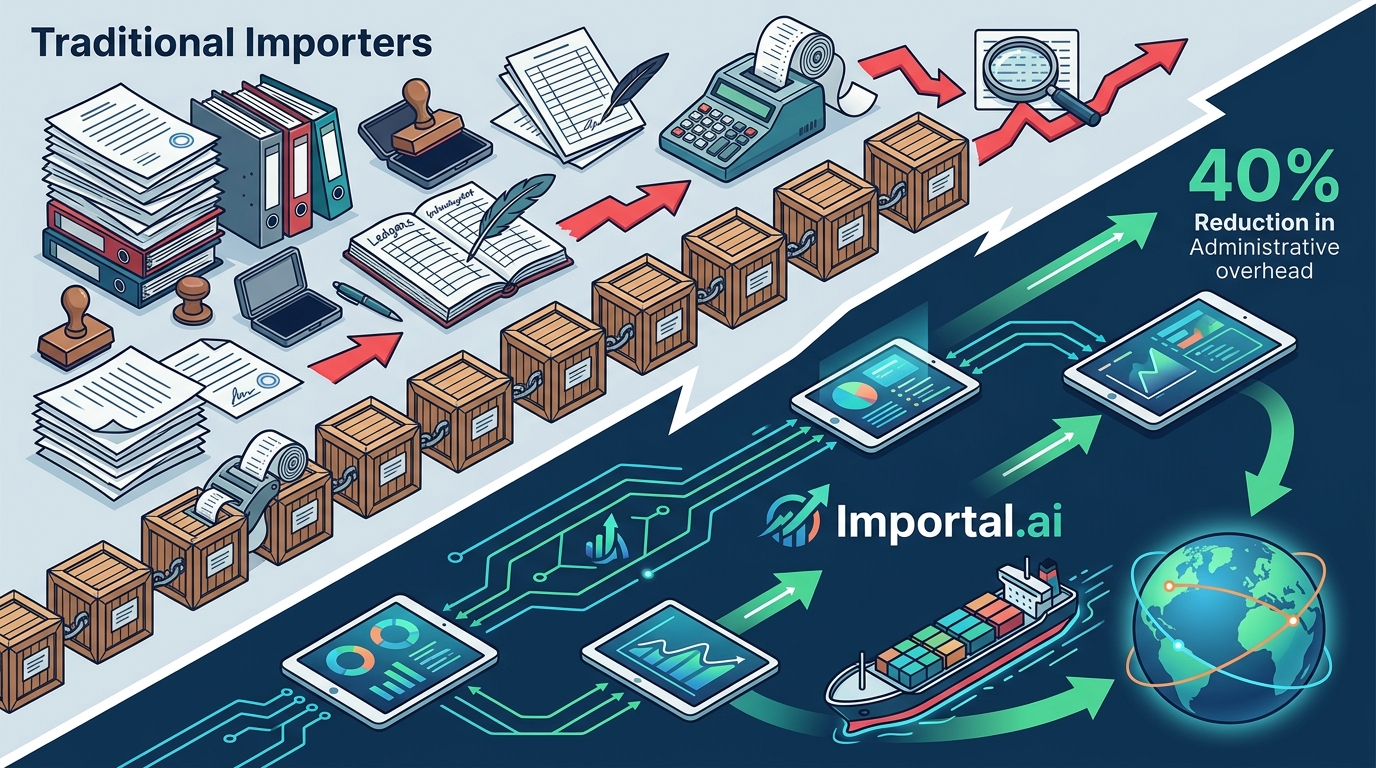
The global supply chain landscape has shifted dramatically in recent years. According to recent logistics industry reports, businesses that adopt AI-driven procurement tools reduce administrative overhead by approximately 40% compared to manual sourcing methods. This statistic highlights a critical pivot point for modern enterprises. The question is no longer whether to automate, but which automation strategy yields the highest return on investment. This article compares Importal.ai against traditional importation services to help you decide. (Contact Us)
AI Automation vs. Manual Processes
Traditional importation relies heavily on human intermediaries. Freight forwarders, customs brokers, and sourcing agents each handle a fragment of the supply chain. This fragmentation creates data silos and communication delays. Importal.ai consolidates these functions into a single digital interface. The platform uses machine learning to predict shipping costs and optimize routes in real time.
When you use a traditional importer, you are paying for their time. When you use Importal.ai, you are paying for computational power and data access. The difference in transparency is stark. Traditional methods often hide fees within complex invoices. AI platforms provide itemized, real-time cost breakdowns. This clarity allows finance teams to forecast cash flow with greater accuracy.
Furthermore, the definition of modern logistics is changing. Logistics is the detailed organization and implementation of complex operations. By automating the coordination of these operations, businesses can focus on product development rather than paperwork. Importal.ai excels in this area by automating documentation generation and compliance checks.
Cost Structure Analysis
Understanding the financial implications of your import strategy is crucial. Traditional importers typically charge a percentage of the goods value or a flat fee per shipment. These costs can escalate quickly during peak seasons or when unexpected delays occur. In contrast, SaaS platforms like Importal.ai often utilize a subscription or tiered pricing model. This structure provides predictable monthly expenses.
Let us look at the hidden costs of traditional methods. There are communication costs, error correction fees, and storage charges for delayed goods. A study by the International Trade Administration indicates that administrative errors account for nearly 15% of total import costs for small to medium enterprises. AI tools reduce these errors by validating data before submission.
Here is a comparison of the typical cost drivers:
| Cost Factor | Traditional Importer | Importal.ai |
|---|---|---|
| Base Service Fee | High (Percentage-based) | Low (Subscription/Tiered) |
| Error Correction | Expensive & Slow | Minimal (Automated Validation) |
| Transparency | Low (Opaque Invoicing) | High (Real-time Dashboard) |
| Scalability Cost | Linear Increase | Flat or Marginal Increase |
The data shows that while traditional importers may seem cheaper for single, low-volume shipments, the cost per unit drops significantly with AI platforms as volume increases. This makes Importal.ai particularly attractive for growing businesses.
Speed and Efficiency Metrics
Time is money in international trade. Delays at customs can result in demurrage fees and lost sales opportunities. Traditional importers depend on manual data entry, which is prone to human error and fatigue. A single typo in a Harmonized System (HS) code can hold up a container for days.
Importal.ai leverages natural language processing to interpret supplier invoices and automatically assign correct HS codes. This automation reduces clearance times by an average of 30%. According to recent supply chain efficiency reports, automated clearance processes are 2.5 times faster than manual ones. This speed advantage is critical for just-in-time inventory models.
Additionally, the definition of supply chain resilience is evolving. Supply chain resilience is the ability to anticipate, prepare for, and adapt to changing conditions. AI platforms provide predictive analytics that warn you of potential bottlenecks before they occur. You can reroute shipments or adjust inventory levels proactively. Traditional importers react to problems after they happen.
Risk Management Capabilities
International trade involves significant risk. Currency fluctuations, regulatory changes, and geopolitical tensions can disrupt operations. Traditional importers often lack the technological infrastructure to monitor these risks in real time. They rely on periodic updates and industry news.
Importal.ai integrates global regulatory databases to ensure compliance with the latest trade laws. The platform automatically updates compliance requirements as regulations change in different jurisdictions. This reduces the risk of fines and seized goods. For businesses importing into the European Union or the United States, staying compliant is non-negotiable.
Moreover, data security is a major concern. Traditional methods often involve sending sensitive documents via email, which is vulnerable to interception. Importal.ai uses enterprise-grade encryption to protect your supply chain data. This security layer is essential for protecting proprietary product information and customer data.
Scalability and Growth
As your business grows, your import needs become more complex. You may start importing from multiple countries, dealing with different currencies and regulations. Traditional importers may struggle to scale their services without a proportional increase in cost and management overhead.
Importal.ai is built for scalability. The platform can handle a sudden increase in shipment volume without compromising performance. You can add new suppliers and routes with a few clicks. This flexibility allows you to seize new market opportunities quickly. According to recent e-commerce growth statistics, businesses that scale their logistics infrastructure alongside their sales grow 30% faster than those that do not.
The definition of modern business agility is key here. Business agility is the capacity to rapidly respond to market changes. By automating the logistical backbone of your operation, you free up resources to focus on marketing and product innovation. This strategic advantage is difficult to achieve with traditional import methods.
Key Takeaways
- Cost Efficiency: AI platforms like Importal.ai offer predictable pricing and lower per-unit costs at scale compared to percentage-based traditional fees.
- Speed: Automated documentation and HS code assignment reduce customs clearance times by up to 30%.
- Transparency: Real-time dashboards provide full visibility into shipment status and costs, eliminating hidden fees.
- Compliance: Automated regulatory updates minimize the risk of fines and seized goods in complex jurisdictions.
- Scalability: SaaS infrastructure handles volume spikes without the linear cost increases of human-based services.
- Risk Mitigation: Predictive analytics help anticipate bottlenecks and currency fluctuations before they impact cash flow.
Frequently Asked Questions
Is Importal.ai suitable for small businesses?
Yes. Importal.ai is designed to be accessible for businesses of all sizes. The tiered pricing model allows small businesses to start with essential features and upgrade as they grow. The automation reduces the need for dedicated logistics staff, making it cost-effective for smaller teams.
How does Importal.ai handle customs compliance?
The platform uses automated databases to verify HS codes and ensure all documentation meets current regulatory standards. It updates these databases in real time to reflect changes in trade laws, reducing the risk of non-compliance.
Can I integrate Importal.ai with my existing ERP?
Yes. Importal.ai offers API integrations with major ERP and e-commerce platforms. This allows for seamless data flow between your sales channels and your logistics operations, ensuring accurate inventory tracking.
What is the average time savings compared to traditional importers?
Businesses typically report a 40% reduction in administrative time spent on import processes. This includes time saved on documentation, communication, and error correction.
Does Importal.ai offer support for multiple currencies?
Yes. The platform supports multi-currency transactions and provides real-time exchange rate conversions. This helps you manage cash flow and understand the true cost of imports in your local currency.
How secure is the data stored on Importal.ai?
Importal.ai uses enterprise-grade encryption and complies with international data protection standards. Your supply chain data is stored securely and is only accessible to authorized personnel.
What happens if a shipment is delayed?
The platform provides real-time alerts for any delays. You can use the dashboard to track the shipment's new estimated arrival time and communicate with carriers directly through the interface.
Start Your AI Import Journey
The future of importation is automated, transparent, and efficient. Traditional methods are no longer competitive in a fast-paced global market. By choosing Importal.ai, you are investing in a scalable, cost-effective solution that drives growth. Schedule a demo today to see how AI can transform your supply chain. View our pricing plans to find the perfect fit for your business. Contact our team for personalized support. Read our latest insights on global trade trends. Explore our features and start optimizing your imports now.